
Antique Lampshades: Restoration, Bespoke Design & Advice

Antique lampshades have a certain something that immediately catches the eye. They are more than simply lighting accessories: they are pieces full of character, craftsmanship and history. In my work, I often meet people who want to restore these objects or find a place for them in their interiors.
Their appeal lies in the quality of the materials, the finesse of the finishes and the patina acquired over time. It is a world where every detail matters, and where authenticity takes precedence over standardisation.
Why choose an authentic antique lampshade?
An authentic antique lampshade stands out for its craftsmanship and quality materials. Unlike mass-produced designs, it was often made by hand, with particular attention paid to stitching, trims and structural details. The textiles may include silk, velvet, linen, taffeta or heavier cotton, often bearing the natural patina of age that gives each piece its distinctive character.
These lampshades have survived through different periods, sometimes even several generations, preserving traces of craftsmanship that is becoming increasingly rare. Their often more elaborate shapes pair beautifully with antique lamp bases, whether Louis XV, Art Deco or Belle Époque in style. Depending on the materials, colours and construction, they can also produce a warm, atmospheric light that brings depth and character to an interior.
Detail of an antique silk lampshade, highlighting the finesse of its finishes.
Restore or Reimagine: Bringing an Antique Lampshade Back to Life
Restoring an antique lampshade requires specific expertise. It is not simply a matter of replacing worn fabric: its construction must first be understood, its proportions respected and the features that give it character preserved. I pay particular attention to the choice of materials, textiles and finishes to ensure they remain consistent with the style, period and structure of the piece. Trims, fringes, passementerie and embroidery all play an important part in achieving this balance.
In some cases, it is also possible to reimagine an antique lampshade rather than restore it exactly as it once was. The existing structure can then become the starting point for a new interpretation, through different textiles, colours, finishes or decorative details, and sometimes even an altered silhouette where the construction allows.
The aim is to create a piece that feels naturally at home in its new setting, without erasing what made the original object distinctive in the first place.
Proportion remains essential. A lampshade that is too large, too small or poorly balanced in relation to its base can completely alter the overall appearance of the lamp. I therefore take the time to consider its dimensions, shape and intended use before recommending the most suitable options.
There is, however, no single universal rule: every lamp and every lampshade has its own particular characteristics.
How Much Does Lampshade Restoration or a Bespoke Lampshade Cost?
The price of a bespoke lampshade varies according to several factors. Its size, the complexity of its shape, the materials selected and the type of finish all directly influence the final cost. A silk lampshade finished with decorative trims and fringe, for example, will generally cost more than a simple cotton design.
For the restoration of an antique lampshade, prices generally start at around €120 to €360 depending on its size, and may increase according to its condition, the materials required and the complexity of the work involved. For a fully bespoke creation, budgets generally start from €700, depending on the dimensions, textiles, finishes and level of customisation required. As every project involves its own specific craftsmanship, a detailed quotation is prepared based on photographs and the characteristics of the piece.
For professionals — interior designers, decorators, hotels, restaurants and heritage properties —, each project is quoted individually according to the quantity required, technical constraints, dimensions and level of customisation. Bespoke design makes it possible to create lighting that responds naturally to the architecture of a space, its proportions, materials and atmosphere, whether for a single statement piece or a coordinated collection.
Incorporating an Antique Lampshade into Your Interior
Incorporating an antique lampshade into a contemporary or traditional interior is above all a question of balance. Not every element needs to belong to the same period; what matters is creating harmony between shapes, materials, colours and proportions. An antique lampshade can work beautifully with a more contemporary lamp base, becoming the element that brings depth and character to the overall composition.
In a boudoir, maximalist or Dark Academia interior, antique lampshades sit naturally alongside wood, velvet, tapestries, bookcases and works of art. In a hotel, restaurant or character property, they can also help create a distinctive and more personal atmosphere, far removed from standardised lighting.
I particularly enjoy working with contrasts: pairing an ornate lampshade with a more understated base, or allowing a highly decorative antique lamp base to sit beneath a simpler shade. What matters most is respecting the proportions of the lamp and the visual balance of the piece as a whole.
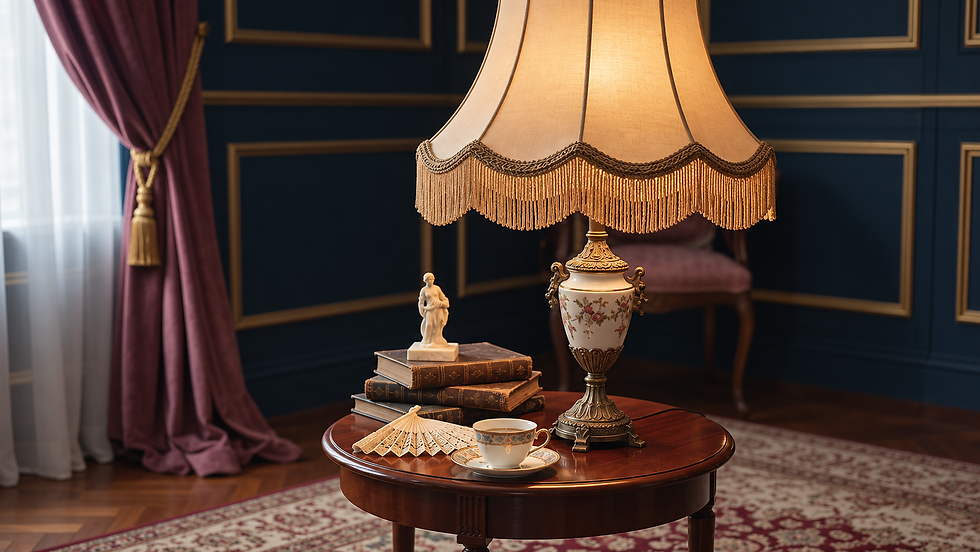
The quality of the light also depends directly on the materials chosen: the colour and density of the textile, the lining and the presence of fringe can all significantly affect how light is diffused. To maintain a warm atmosphere while protecting the materials, I generally recommend a warm LED bulb suited to the lamp.

Lamp fitted with an antique velvet lampshade, creating a soft, atmospheric light.
The Craftsmanship Behind Every Antique Lampshade
What fascinates me about working with antique lampshades is the precision required by their construction techniques. Every stage — preparing the frame, cutting and tensioning the textiles, applying trims, fringe or passementerie — requires time, consistency and a genuine understanding of the piece.
The choice of materials is essential. It is not simply a matter of appearance, but also of how a material behaves, its thickness, transparency and compatibility with the existing structure. A textile or finish may be beautiful and yet entirely unsuitable for a particular project.
Patina and the marks left by time are also among the things I assess before any work begins. They are not automatically flaws that need to disappear. When they can be preserved without compromising the piece, they contribute fully to its character. Conversely, materials that have deteriorated too far sometimes need to be replaced so that the lampshade can regain a sound and durable structure.
Restoration therefore means knowing what to preserve, what to repair and what is better replaced. Every lampshade is different: its period, construction, condition and intended use determine the technical choices required. The aim is not to erase the years, but to preserve as much as possible of what deserves to remain while allowing the lamp to continue to be used safely and appropriately.
Preserve Rather Than Replace
Choosing to restore an antique lampshade also means choosing to preserve an existing object rather than automatically replacing it with something new. When a structure can be retained, repaired or recovered, it can continue its journey rather than being discarded in favour of a standardised product.
This approach contributes to the preservation of decorative heritage, while also retaining what makes a piece distinctive: its proportions, materials, construction, patina, or simply the connection it holds to a family history or a particular place.
Restoration does not, however, mean preserving everything at any cost. Elements that have become too fragile may need to be replaced to ensure the lamp remains sound and usable. The challenge is to intervene with discernment, preserving as much as possible of what deserves to remain.
It is also a way of championing more individual interiors, composed of objects chosen for their character rather than their conformity to current trends.
Antique lampshades are more than decorative accessories. They reflect the techniques, materials and aesthetic sensibilities of their time. It is precisely this heritage that I care about preserving, restoring and, at times, reinterpreting.
Whether you would like to restore a family piece, transform an existing lampshade or incorporate one into a more contemporary interior, I can help you find the approach best suited to its condition, intended use and surroundings.
Do you have an antique lampshade to restore or reimagine, or a completely bespoke project in mind? Discover the atelier’s restoration and bespoke creation services to find the solution best suited to your piece and your interior. You can also contact me directly to tell me about your project and send me a few photographs.
Thank you for reading. I hope this article has given you a new perspective on antique lampshades and the possibilities they offer.
Luminously yours,
Annaëlle Emery


Comments