
Lampshade Restoration: Can a Torn or Damaged Antique Shade Be Saved?

Torn fabric, a loose lining, missing fringe or a distorted frame… Over the years, antique lampshades can develop considerable damage, sometimes to an alarming extent.
When it comes to a family heirloom, an inherited piece or a flea market discovery, however, the thought of parting with it can be difficult.
But is it really possible to repair an antique lampshade when it appears severely damaged?
In many cases, yes. Restoration can preserve its original silhouette, recreate its decorative finishes or replace elements that have become too fragile.
It all depends on its construction and the condition of the different materials from which it is made.

Lampshade Restoration: What Types of Damage Can Be Repaired?
Not all antique lampshades age in the same way. Fabrics, papers, decorative braids and metal frames react differently to time, heat, humidity and handling.
Several types of damage can be addressed through restoration.
Torn, Worn or Fragile Fabric
Antique silk, for example, can become extremely brittle over time. Eventually, it may split or begin to disintegrate at the slightest touch.
When the fibres have deteriorated too severely, simple stitching is generally not enough to provide a lasting repair.
It may therefore be preferable to replace the fabric while preserving the lampshade's original shape and, whenever possible, some of its original decorative elements.
New fabrics can be carefully selected to recreate the colour, texture or translucency of the original material.
A Torn or Yellowed Lining
The inner lining plays an important role in the appearance of a lampshade, particularly when the lamp is illuminated.
Over time, it may tear, become loose, develop stains or grow extremely fragile. Depending on the shade's construction, the lining can sometimes be replaced independently of the outer fabric.
The choice of a new lining also makes it possible to achieve a suitable diffusion of light, without necessarily changing the lampshade's exterior appearance.
Missing Fringe, Braids or Decorative Ornaments
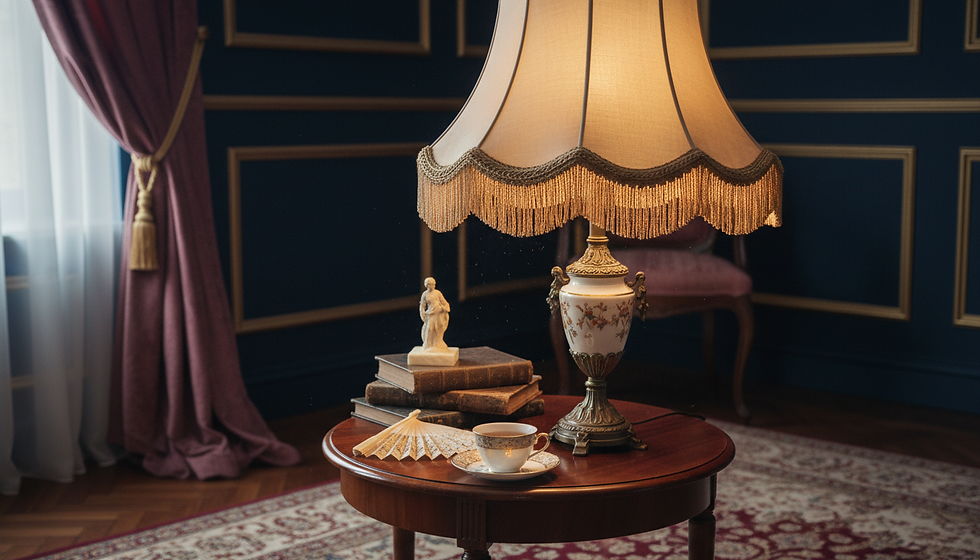
Antique lampshades sometimes feature particularly elaborate finishes: fringe, decorative braids, cords, lace, beads or glass drops.
Some elements may become detached, fade or disappear over the years. When their condition allows it, original decorative ornaments can be preserved and reused.
Otherwise, suitable trims can be sourced or recreated to respect the original character of the piece.
The aim is not necessarily to make the lampshade appear brand new, but to restore a harmonious appearance that remains faithful to its history.
Can the Original Frame of an Antique Lampshade Be Preserved?
The frame is the structure that gives a lampshade its shape.
On certain antique pieces, it features unusual silhouettes: pronounced curves, shaped panels, scalloped edges or distinctive proportions.
Preserving this structure is often one of the most important aspects of a restoration.
A slight deformation does not necessarily mean that the frame must be replaced.
However, it is important to examine the condition of the metal, the strength of its joints, any signs of corrosion and the overall stability of the structure.
When the frame is sufficiently sound, it can serve as the foundation for replacing the fabrics and decorative finishes.
If the frame is too badly damaged, repairing certain sections or creating a suitable reconstruction may be considered after examination.
What If the Antique Lampshade Is Almost Completely Destroyed?
This situation is less unusual than one might imagine.
Sometimes, the fabric has been reduced to a few fragments, the paper is disintegrating, or the original decorative finishes can no longer remain in place.
In such cases, repairing an antique lampshade does not always mean physically preserving every original material.
Restoration may require a complete reconstruction.
The surviving elements, measurements and old photographs then become valuable references for recreating the lampshade's original silhouette and character.
A Restoration Project from the Atelier

Two antique chandeliers that had belonged to their owner's parents were entrusted to my atelier, along with four severely deteriorated paper lampshades.
The original coverings could no longer be repaired in the usual way.
I therefore worked on recreating them, using hand-tinted parchment-style paper, made entirely to measure, to reproduce the original warm sand and caramel tones, together with their copper-coloured decorative edges, also recreated to measure.


This project illustrates an important distinction: sometimes, preserving the identity of a light fixture means recreating certain elements rather than retaining materials that can no longer be used.
Should You Repair an Antique Lampshade Yourself?
It depends on the type of work required.
A small detached ornament does not necessarily call for the same approach as torn fabric, a distorted frame or brittle antique paper.
Fragile materials can be difficult to handle. An unsuitable adhesive, excessive tension or the removal of a decorative braid can sometimes make the damage worse.
When a lampshade holds significant sentimental, historical or decorative value, it is preferable to have its construction examined before attempting an irreversible intervention.
An initial assessment helps determine what should be preserved, what can be repaired and what may need to be replaced.
How Much Does Antique Lampshade Repair Cost?
The price depends on several factors:
The dimensions and shape of the lampshade
The condition of its frame
The type and quantity of fabric to be replaced
Whether a lining is required
The complexity of the braids, fringe and other ornaments
The time required for dismantling, restoration and finishing
A small, localised repair and a complete restoration naturally involve very different amounts of work.
To better understand the factors that influence a quotation, you can read my article about the cost of antique lampshade restoration.
How Can You Tell If Your Antique Lampshade Can Be Repaired?
You do not need to know its exact age or construction technique to request an initial assessment.
A few photographs are often enough to begin assessing your piece.
Ideally, please photograph:
The entire lampshade, unlit, preferably on its lamp base
Its interior and frame
Any damaged or missing areas
The decorative elements you would like to preserve
Include its measurements (height, top diameter, bottom diameter and slant height), along with a few words about its history and your desired result.
This information will help me consider the initial restoration options, subject to confirming the condition of the piece during its examination.
Entrust Your Antique Lampshade to a Specialist Restoration Atelier
At L'Héritière des Belles Ombres, an independent atelier based in Aussevielle, near Pau in southwestern France, I assist owners of antique lampshades with their restoration, recovering and reconstruction projects.
My work focuses on preserving the character of each piece as much as possible, whether that means recreating its original appearance or adapting certain details to the owner's wishes.
Projects can be assessed in person or remotely, throughout France and internationally.
All lampshades can be shipped to the atelier, regardless of their dimensions or fragility, using protective packaging tailored to each individual piece. You can find practical guidance in my article on how to pack and ship a lampshade for restoration.
Is your lampshade torn, misshapen or seemingly beyond repair?
Before parting with it, tell me about your piece. A few photographs are often enough to begin exploring the restoration possibilities.


Comments